Dear Mythology Students,
If you missed class on Thursday, October 30th, we discussed the Greek underworld of Hades. Each student received a red handout, which we completed together. Several overheads were shared with you in relationship to the areas we discussed. I have attempted to include some of the images for you here.
HOMEWORK:
1. Please read the myth of "Orpheus and Eurydice" located on pg. 107 in your textbook. This myth illustrates how just Hades was concerning those that entered his domain.
2. Please read the myth of the "Danaids" located on pg. 295 in your textbook. This myth pertains to one group of sinners within Hades.
3. Please read "Tantalus" pg. 348-the top paragraph on 349
4. You will have a QUIZ covering the myth of "Orpheus and Eurydice" on Monday, Nov. 3rd.
5. You will have a QUIZ covering HADES on Wednesday, Nov. 5th
The following pictures should give you greater insights into some of the aspects we discussed on Thursday. Please make sure you obtain the information from someone else in class upon your return.
 This is the character known as Sisyphus. He was destroyed by Zeus due to his inappropriate sexual behavior. His punishment is to push a boulder up a large mountain in Hades, with the one purpose of pushing it over the top. He is never successful in doing so, as the boulder always comes crashing down on him. This punishment is highly symbolic of the crime, as the rock represents Sisyphus' sexual desires. He hopes to overcome them, but he he is unsuccessful in doing so.
These women are known as the Danaids. There are fifty of them, and on their wedding night, all but one, murdered her husband by stabbing him in his heart. Their punishment in Hades is to obtain water from the River Styx with the hope of filling Hades' garden pond; however, their jars have holes in the bottom. They were never able to complete the mundane task of filling the pond. This is symbolic of the fact that they took the trivial and mundane away from their husbands; consequently, they are forever cursed with it.
 This is the character known as Ixion. He attempted to rape Hera. Zeus had him strapped to a wheel of burning fire. This is symbolic of the fact that a rapist will continue to rape unless caught...hence the wheel. The fire on either side is symbolic of the pain the victim feels. Ixion was constantly burned, but never burned away. OUCH!
Tantalus is another sinner in Hades. He murdered his son, and then fed his flesh the gods in the form of a stew. The Olympians were so appalled by Tantalus' behavior that they cemented him within Styx, being cursed with perpetual hunger and thirst. Each time he attempted to drink from Styx the water would move away from him. There are fruit trees hanging above his head, and yet each time he attempted to grab some of the fruit it would move away from him. He is perpetually hungry and thirty.
Can you recognize that each punishment is symbolic of its crime!

 1. What is being depicted in this ancient sketch. You should mention the male
 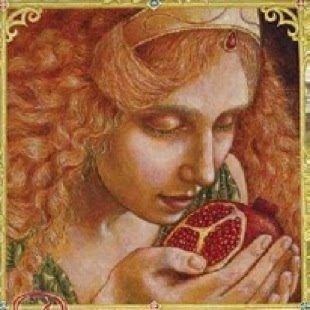 2. Identify this lovely lady. The fruit she is holding is a strong clue as to her identity.
  3. What is taking place in this sketch. In your response, you will need to identify the female character.
 5. I LOVE THIS PAINTING, because I feel the artist has


 9. Who is this Greek god? In addition, explain the myth concerning the symbol depicted behind her.
 10. What is this? Identify the characters associated with this symbol and in what capacity. How is this ancient symbol relevant to people living in the 21st century?


 Hello, Mythology Students,
 1.Identify this Greek character.
 2.Explain what has just taken place in the above sculpture. You should mention two characters by name (use Greek and Roman).
 3. Identify the primary Greek/Roman Character in the above sculpture.
 4. This would not have been a pleasant experience for the women in the painting. Who are these two individuals? Why is this event taking place? In your response you should mention a female character that is not present.
 6. Identify this character (general term is fine). What is his significance to drama?


 This image depicts Oedipus with two of his children, Antigone and
  This image depicts a theater troupe performing the play of "Oedipus Rex." The character of Oedipus is in the center, and the chorus members are around him.